
Attorney Jim Desmond

Experience the Desmond Difference

desmond law logo e1638986956938 768x573

  • My Attorney Fees
    • Fee Pitfalls of Other Attorneys
  • Practice Areas
    • Car Accidents
    • Motorcycle Accidents
    • Tractor Trailer Accidents
    • Wrongful Death Laws
    • Personal Injury
  • Testimonials
    • Client Reviews
    • Attorney Endorsements
  • Social
  • Media Interviews
  • Injury Blog
  • Free Resources
  • Contact

Category: Insurance Issues

Going Against the At-Fault Driver in a Kentucky Car Accident

Below is a summary that ChatGPT provided me with regarding how fault affects Kentucky car wreck cases.  In Italics, I have put my comments wherein I thought AI got it right or wrong in describing the law regarding Kentucky automobile accidents.

Going Against the At-Fault Driver in a Kentucky Car Accident

(Fault, Negligence, and Pain-and-Suffering Claims Explained)

Once Kentucky’s no-fault (PIP) benefits are used up or the legal injury threshold is met, an injured person may pursue a claim against the at-fault driver. At that point, the case is governed by traditional negligence law. (Wrong.  ChatGPT is confusing concepts.  You have the legal right to sue someone, whether your PIP is exhausted or not.  Further, the legal injury threshold, oversimplified, is having at least $1,000 in medical bills from a car wreck.  That threshold applies only to Kentucky wrecks and your personal injury claim. That threshold does not exist, for example, for wrecks occurring in Indiana, and/or against your property damage claim.)


What “Negligence” Means in a Car Accident Case

To hold another driver legally responsible, the injured person must prove negligence. Negligence has four basic elements:

1. Duty
Every driver has a legal duty to operate their vehicle safely and follow traffic laws. (Yes, but it is really a duty to keep (It’s broader than this.  Duty refers to the fact that you must have a legal duty under the law, e.g., yielding the right of way.)

2. Breach of Duty
A driver breaches that duty by doing something unsafe, such as:

  • Running a red light or stop sign
  • Failing to yield the right of way
  • Speeding
  • Distracted driving
  • Following too closely

(The above are examples.  Most traffic cases are determined by who had the right of way.)

3. Causation
The unsafe conduct must be a substantial factor in causing the crash. (Correct.  For example, you can’t hold the Drive-Thru Hamburger place responsible for taking too long with the order; even though, had they been on time with the order, you would have avoided the wreck since you would not been at the intersection when the other guy ran the red light.)

4. Damages
The crash must result in actual harm, such as:

  • Physical injury
  • Pain and suffering
  • Medical expenses
  • Lost income

(It failed to mention the damage to your car.)

If any one of these elements is missing, the at-fault driver is not legally responsible. (True. You need all four elements to make a successful personal injury claim.)


Why “Right of Way” Often Determines Fault

In most car accidents, fault comes down to who had the legal right of way.

Examples:

  • A driver who runs a red light usually violates the other driver’s right of way.
  • A driver turning left must yield to oncoming traffic.
  • A driver entering a roadway must yield to vehicles already on it.

When a driver violates right-of-way rules, that violation is strong evidence of negligence because:

  • Traffic laws are designed to prevent collisions
  • Violating them creates a foreseeable risk of harm

While not every crash is simple, right-of-way violations are the most common cause of fault in Kentucky car wrecks.  (True.  Think about why that is the case through this example.  Many drivers try to say, “Well, the other guy was speeding!”  Yes, but that is only a small factor in causing the car wreck. First of all, you would have to be able to prove that but for the other driver’s speeding, the wreck could have been avoided.  Second, and more importantly, you turned left in front of the other driver, thereby breaching your legal duty to yield the right of way to oncoming traffic. That other driver could have been doing 100 mph, and had you not entered his path of travel, there would not have been a collision. That’s why a high rate of speed, if you can prove that the car was in fact speeding, is only considered a factor in causing the wreck, and the substantial cause of the wreck was failing to yield the right of way.)


Comparative Fault: More Than One Driver Can Be at Fault

Kentucky follows a pure comparative fault system.

This means:

  • More than one driver can share fault
  • Each driver is assigned a percentage of responsibility
  • An injured person’s recovery is reduced by their percentage of fault

Example:

  • If damages total $100,000
  • And the injured driver is found 20% at fault
  • The recovery is reduced to $80,000

Even a driver who is mostly at fault may still recover something under Kentucky law.  (Correct.  So in the above example, not only would your damages be reduced by 20%, but also, that other driver would have a claim against you for 20% of their damages.)


Recovering Pain and Suffering Damages

“Pain and suffering” includes:

  • Physical pain
  • Emotional distress
  • Loss of enjoyment of life
  • Ongoing limitations or discomfort

(True, let me say this.  The merits of a personal injury claim are determined by the contents of your medical records. For complaints of pain to be taken as credible by an insurance company, those complaints need to be noted in your medical records, and your treating physician MUST relate those complaints to the injuries sustained in the car wreck.  Plain and simple, when it comes to car accidents, the treating physicians are seen as gods, and their testimony makes or breaks a case.)

To recover pain and suffering damages in Kentucky:

  1. The injured person must meet the KMVRA threshold (such as medical bills over $1,000 or a qualifying injury), and
  2. The at-fault driver’s negligence must be proven

Unlike medical bills or wage loss, pain and suffering:

  • Has no fixed dollar amount
  • Is evaluated based on the severity, duration, and impact of the injury
  • Is often the most contested part of a claim

(On this last part, wherein Chaptgpt says an injury claim is the most contested part of a claim, understand that the best personal injury claims follow the concept of “Garbage in equals garbage out!”.   In other words, give your injury attorney the best facts to work with, and by doing so, your result may be a higher recovery on your injury claim.  For example, if you are hurting and the impact made your car look like an accordion, take the EMS ride to the Emergency Room and get checked out.  If you have not been to the doctor in weeks and are still hurting from a car wreck, get to the doctor and document the fact that you are still hurting. If you don’t, it looks like you were not hurting during that time.  Essentially, your medical records are the ‘Hansel and Gretel breadcrumb trail’ that leads an insurance company to the conclusion that you were seriously injured in the car wreck.)


Evidence Commonly Used to Prove Fault

Fault is usually established using a combination of:

  • Police reports
  • Traffic citations
  • Witness statements
  • Photographs and videos
  • Vehicle damage patterns
  • Medical records linking the injury to the crash

No single piece of evidence controls the outcome. Fault is determined by the total picture. (I don’t agree with most of ChatGPT’s statements on this.  The police report is evidence of fault but is generally not admissible as evidence during trial.  Traffic citations help, but only if they concern how the vehicle was being driven, e.g., the other driver was intoxicated or charged with reckless driving; a citation for an expired registration means nothing for a personal injury claim. Personal injury claims arising from a car accident are all about what we can prove.  So yes, videos that captured the car accident, statements of witnesses, or photographs that show the position of the vehicles after the wreck, all help us to prove fault.)


Property Damage Follows Fault Rules from the Start

Unlike injury claims:

-Property damage is not limited by the no-fault law

-The at-fault driver is responsible for:

  • Repair costs
  • Total loss value
  • Loss of use (such as rental car expenses)

Fault analysis for property damage is the same negligence analysis described above.


Bottom Line

Once no-fault limits no longer apply, a Kentucky car accident claim becomes a traditional fault-based case. The injured person must prove that the other driver violated traffic rules, caused the crash, and resulted in real harm. Right-of-way violations frequently determine fault, and damages may include medical expenses, lost income, property damage, and pain and suffering, subject to comparative fault rules.

(True, quit putting such emphasis on the no-fault laws. They are not hard to comply with, and really, Kentucky is a traditional fault-based system for the most part, and the no-fault laws are just several exceptions to that system.)

Filed Under: Car Wrecks, General Blog, Insurance Issues, Personal Injury Tagged With: Attorney Jim Desmond, automobile accident attorney, Louisville automobile accident lawyer, Louisville car wreck attorney, settle for policy limits, UIM coverage, Under insured motorist coverage, underinsured motorist insurance

Accountability Matters: Holding At-Fault Drivers Responsible

If you’ve been injured in an automobile collision, your medical bills will add up quickly.  This is especially true if you are still treating.  If those medical expenses exceed the other person’s insurance limits, are we letting the at-fault driver off the hook if we settle for their policy limits?  We are not.

The Kentucky state minimum in insurance is $25,000 per person.  This means as long as someone has $25,000 in insurance coverage per person, they are driving lawfully.  What it does not mean is that they have enough insurance to cover your medical bills or your claim for pain and suffering.  So, can I sue the at-fault driver and refuse to accept the settlement of $25,000, their policy limits? The answer is “Yes” but, I don’t recommend it.  Read further to understand why.

attorney Jim Desmond discusses letting the at-fault driver off the hook

If you sue someone, you are trying to get a judgment against them and then collect on that judgment. Well, if a person does not have any assets such as real estate and bank accounts, how are you going to collect on that judgment? The clear answer is you won’t.  As the old saying goes, you can’t get blood from a turnip.

So, instead of trying to sue someone beyond their insurance coverage, the better route is to put your insurance company on notice of an underinsured motorist claim.  In a recent case I am handling, I found $50,000 of underinsured motorist coverage that applies to the claim.

After I comply with a legal procedure known as Coots, see KRS 304.39-320, and your insurance carrier consents to you accepting the $25,000 offered by the at-fault driver, your insurance carrier acts like they insure the at-fault driver for another $50,000, in the case I am presently handling.

By filing the underinsured motorist claim, we have the ability to recover more dollars, beyond the $25,000, on your behalf.  Your insurance carrier, not you, will bear the burden and expense of suing the at-fault driver to recover any funds they pay out to you.

No one plans to get into a car wreck.  The results often complicate our lives in ways we never imagined.  While settling for the at-fault driver’s policy limits, even when your medical bills exceed that amount, it doesn’t mean we are letting the at-fault driver off the hook.  As an experienced automobile accident attorney, I highly recommend you review your auto insurance policy to make sure you and your family members have enough uninsured and under insured (UM/UIM) coverage.  It’s a step you can take to make sure you’re protected when the unexpected happens.

If you’d like to listen to my podcast episode explaining Uninsured and Under Insured Motorist Coverage, click below:


I’m attorney Jim Desmond.  If you would like to speak with an experienced car wreck attorney, call me on my cell phone.  My number is (502) 609-7657.  I’ll be happy to listen to you about your specific situation.

Principal office located in Louisville, KY.

This is an advertisement.

Filed Under: Car Wrecks, General Blog, Insurance Issues, Personal Injury Tagged With: Attorney Jim Desmond, automobile accident attorney, Louisville automobile accident lawyer, Louisville car wreck attorney, settle for policy limits, UIM coverage, Under insured motorist coverage, underinsured motorist insurance

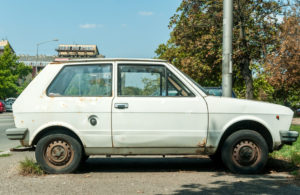
Reflecting on Past Injury Cases: Lessons from the Yugo

Does anyone else remember the Yugo? It was a car built by the former Soviet Union in the 1980’s.  Its reliability was so bad that you would have been better off driving a Ford Pinto than buying that car.  Well, no matter they try to claim otherwise, there is no way any personal injury attorney, including the law firms that claim to be so BIG, can make it so that Yugo can win the Indianapolis 500.

the yugo

Buying car insurance is like buying an automobile.  If you buy the Yugo, you may save money up front but you will have a whole lot issues with reliability, repairs, etc.  However, that does not mean you need to buy a Mercedes either.  You need a solid insurance policy that will protect you in most circumstances and by doing so, you give your personal injury attorney something good to work with. It does not have to be perfect insurance all the time but rather, it just has to be good enough so that we, car accident lawyers, have the means of keeping you from going backwards for a car wreck that was not your fault.

You see, as much as the critics want to claim that we are just a bunch of ambulance chasers and car wrecks are just a get rich quick scheme, the real goal of any good personal injury lawyer should be keeping their client from suffering financial hardship from a car accident that was not their fault.

Well, if you have read my blogs previously, you know that I like to rant and the chances are that this blog stems from a situation frustrating my client and me.  This time, we are dealing with a three car, pile-up wherein my client is being accused of not stopping his vehicle in time; even though he was hit in the rear end and pushed into the vehicle at the front of the line.

Recall that Kentucky is a pure comparative fault state which means in a car accident case, that fault can be divided among the drivers anyway a jury wants to as long as the total adds up to 100%. In this case, the insurance company is arguing that they don’t owe 50% of the damages as those damages, allegedly, stemming from my client hitting the first vehicle that had already stopped.  If I was not clear, my client was the middle car in a three-car pile-up. So, in essence, the insurance company for the at-fault company is denying fault for part of the car wreck.  So, back to the Yugo and how to protect yourself.

First, all my preaching about uninsured and underinsured coverage does not apply here as all vehicles involved were insured and my client was not badly injured. However, it just as easily could have applied. If my client had a surgery from this car wreck, I could see a situation wherein underinsured coverage on his own vehicle could come into play, even if the other driver was only accepting 50% fault for the wreck.

For example, assume the client has a $100,000 surgery and the other driver was only insured for $25,000.  If the insurance company is successful in asserting the 50% responsibility (based on the comparative fault issue I covered earlier), the potential liability for the at-fault driver would be $50,000.  However, even if their insurance company agrees to pay the policy limit of $25,000, there’s still $25,000 of medical bills remaining, not including the client’s 50% portion ($50,000 for comparative fault).  Therefore, a good lawyer would be making an injury claim against the underinsured motorist coverage for at least the other 25% of medical expenses.

So yes, to say it again, always have at least $100,000 per person of uninsured and underinsured motorist coverage on your motorcycle and car insurance.

What does come into play for this wreck is the collision coverage on my client’s own automobile insurance policy.  Since the at-fault carrier is unwilling to pay for all of the damage to my client’s vehicle, we can use that collision coverage to pay for the damage to the car and my client is only out his deductible. This way my client can get his car fixed and back on the road while I have time to potentially litigate the issue of fault.

What if he did not have this collision coverage?

Then we would be between a rock and a hard place because he has a car that needs repairs to be operational and yet, he has no way of paying for these repairs. To complicate matters, lawsuits wherein we are trying to prove to a jury that the other driver was at fault, usually last anywhere from 18 months to several years.

In essence, we would need time to prove the other driver caused the wreck and of course, the client does not have time because he would be without a vehicle.  So back to the original point which is, the better insurance you buy before the car wreck happens the greater tools you give a car accident lawyer to work with if an accident occurs.  After all, the Yugo will get you there, but it may not have been the best option in the long run.

For more information, listen to my Kentucky Auto Accident Podcast or watch some of my personal injury videos on the website.  Remember, you can always call me on my cell phone at (502) 609-7657.

Filed Under: Car Wrecks, Insurance Issues Tagged With: car wreck, comparative fault in Kentucky, underinsured motorist insurance

In-Depth Legal FAQs: Comprehensive Answers to Car Wreck Queries

Episode 13: On today’s episode, Jim Desmond answers Frequently Asked Questions. Let’s face it, it is hard to understand the law if you aren’t a lawyer and even if you are one, it can still be challenging to work through all of the issues involved in car wrecks. Today we will be answering questions and hopefully be able to help you to better understand when auto accidents.

Car Wreck Attorney Jim Desmond

Do I have a personal injury claim if I do not have car insurance?

The answer is yes. This happens to be one of the biggest things that people mess up. In Kentucky, if you don’t have car insurance, you cannot recover the first $10,000 of your medical bills. In Indiana, there is not a penalty. If the other driver is at fault and insured, then you still have a personal injury claim. If you are unsure or turned away from other law firms, it’s important to keep trying. It is very important to try to be insured because then you won’t be penalized and there’s a possibility to make an underinsured claim, which says basically that your damages are more than what you may be recovering from the at-fault driver.

Why do I have to use my car insurance for the medical bills if I was not the one who caused the wreck?

In Kentucky, the idea is that you should not have to show fault or liability on a driver to get your medical treatment. If you get in a car accident, no matter how it happens, you are immediately entitled to $10,000 in medical expense coverage, which is called no-fault insurance. It’s not just your medical expenses covered, it also can apply to loss wages and loss of services and this even goes for the passengers of the car. It doesn’t mean you can’t recover the $10,000 back, you just have to pay it up front. The reason that Kentucky has that is because in exchange for that right, we give up the right to recover the first $10,000 in medical bills. It’s good because you have money there that can help you if you were to get hurt. The first question when it comes to car accidents is who is insured and for how much?

How do I get my car fixed after a car wreck?

You have two ways to get your car fixed. The first is when you are in an accident, police will usually arrive and take the drivers’ insurance and stories. After that, you wait for your police report, because that gives you the other driver’s information. This allows your attorney to contact the other driver’s insurance company to start a claim. Unless the person who hit you takes responsibility, the insurance company is allowed to investigate the case. The issue if they don’t take responsibility, is your car will just sit there. The second is if you have collision coverage on your car, you can use that. The downside of this is you lose your deductible. Later, you can get this back if the other driver is at fault.

How do I get the rental car extended?

If your car is fixable and at a repair shop, it won’t be that hard to get it extended because the body shop should be staying in touch with the insurance and keeping them updated. When the car is a total loss, they will owe you fair market value. This can be hard because you may have put a lot of money into the car to keep it driving, but they will see it as it is. Sometimes you can argue for more, but there’s really no way around it. When your car is totaled, the insurance company will limit how long you will get to use a rental car for, the average is usually 10-14 days from the day of the accident.

If you’re in an accident and the other insurance is not accepting fault right away, what should the driver do?

You should open the claim and talk to a lawyer. Many times, they will send investigators out and look at the area.  Sometimes, we’re lucky enough to find cameras which may have recorded the accident. Another important thing is to get the witnesses’ information and don’t rely on the police officer. Sometimes people’s numbers change, or numbers can be wrong, so it is important to have those contacts. If you are waiting for the other driver to accept fault, they do have a reasonable amount of time to go through everything with their insurance and to investigate. Usually the more information you have, the faster it will be.

Why would I involve my health insurance if the other side hasn’t paid my medical bills yet?

The first thing to understand is that the other side won’t pay anything until they pay for everything at once. They do this so they won’t be making multiple payments. The other insurance adjuster will try to dispute everything and try to see if your injuries could be from preexisting issues. Usually, before you are seen, they will want to use your medical insurance for co-pays, which you’ll have to pay to get treated. One key step is to reserve the no-fault coverage, because that $10,000 can be used to pay things like co-pays or deductibles.

Are attorney fees negotiable?

Yes. There is no law that requires an attorney to ask for a certain amount for personal injury cases. The standard for a car wreck case is 1/3 of what you recover and 40% if it goes to a lawsuit. Most injury lawyers use contingency fees, which means the client owes nothing unless something is recovered. It costs 1/3 because some cases can take more than a year to resolve.

Will I make more money going to court rather than settling a few months in?

If you go to trial, it’s like walking into a casino because you are trying to convince 12 people that your claim is worth so much money. On the other side, the defense is saying your claim is not worth that much. A lot of people think suing will get you more money, but that’s not always the case. It really depends on the value of the case. Court costs also become extremely expensive and very timely.

For more information about Louisville Car Wreck Attorney Jim Desmond, visit www.AttorneyDesmond.com.

Important Disclaimers:

The information provided on this podcast is for general informational purposes only.  It should not be construed as legal advice and does not constitute an attorney-client relationship.  You should seek the advice of an attorney for guidance related to your specific situation.  I am only licensed in Kentucky and Indiana, so the general advice provided may not apply outside of those states.

This podcast maybe freely shared, but may not be the modified or edited in any way.  This is an attorney advertisement. Principal office is located in Louisville, KY.  Co-host Jim Ray is a non-attorney spokesperson.

Filed Under: Car Wrecks, Insurance Issues, Personal Injury, Podcast Tagged With: automobile accident attorney, car wreck

Motorcycles and COVID-19

Episode 12:  On today’s episode, Jim Desmond discusses motorcycles and COVID-19. Right now, in the world, people are struggling with let’s face it, Cabin Fever. With nice weather happening, motorcycle riders are taking full advantage. The biggest concern is now there may be drivers with no insurance or less insurance coverage than before due to lack of working or even lack of driving. When people are not driving, there comes a point of “Why am I paying for insurance that I’m not using?”

Louisville personal injury lawyer discusses the risk of motorcycles and COVID-19

The problem with driving a motorcycle is that if there were an accident, the damage will be much greater than if you were hit in a car. It is important to protect yourself by having a policy set in place in case you were to get hit. Motorcycle coverages are treated differently and viewed differently because Kentucky has a no-fault policy. That means motorcycles will not be automatically covered.

There are 3 coverages that protect you as an operator of a motor vehicle. The first is no-fault coverage, which means your medical bills are covered by the vehicle you’re in for up to $10,000 immediately. This could also be loss of wages and other elements. The second is uninsured, which means your company may act like they insured that other driver. Then there is under insured coverage, which means there isn’t enough insurance available via the at-fault drivers’ coverage.

Uninsured or Underinsured coverage on any automobile or motorcycle policy you have on at least $100,000 per person will give your lawyers the tools they need to work with. You should always prepare for the worse case-scenario. There have been many times where the coverage will not match the damage. Most people had to learn the hard way.  This is especially true when we consider the unfortunate relationship between motorcycles and COVID-19.

On a motorcycle, no-fault (or PIP coverage) is not automatic. In fact, they penalize motorcyclist. You will have to use your health insurance to get everything covered. The law goes on to say that the motorcyclist driver cannot recover the first $10,000 of their medical bills they treat them as if they are uninsured. The passenger cannot recover the no-fault coverage, but they can have their medical bills covered.

If you ride a motorcycle, you cannot assume any aspect of your automobile insurance will apply. There are often exclusions that may be hard to find on the contract regarding whether the coverage also applies to motorcycles.

If you or a loved one is in a motorcycle accident, it’s important to document everything. Get the contact information of witnesses and take pictures of the accident and maybe even your wounds. If there is a surveillance camera, it is important to try to get the tape. You have 3 claims you can make in a car wreck/motorcycle accident: property damage, medical bills, and pain and suffering.

Remember the key risk between motorcycles and COVID-19 isn’t that you’re going to get sick.  It’s that the other drivers on the road may have reduced or cancelled their car insurance in an effort to save money.  You are now at a much higher risk of getting stuck with significant medical bills.

For more information about Louisville Personal Injury Attorney Jim Desmond, visit www.AttorneyDesmond.com.

Important Disclaimers:

The information provided on this podcast is for general informational purposes only.  It should not be construed as legal advice and does not constitute an attorney-client relationship.  You should seek the advice of an attorney for guidance related to your specific situation.  I am only licensed in Kentucky and Indiana, so the general advice provided may not apply outside of those states.

This podcast maybe freely shared, but may not be the modified or edited in any way.  This is an attorney advertisement. Principal office is located in Louisville, KY.  Co-host Jim Ray is a non-attorney spokesperson.

Filed Under: Insurance Issues, Motorcycle Accidents, Podcast Tagged With: covid-19, motorcycle accident, Motorcycle Coverage Issues, Motorcycle Insurance

  • 1
  • 2
  • 3
  • …
  • 5
  • Next Page »

Copyright © 2026 · AttorneyDesmond.com